
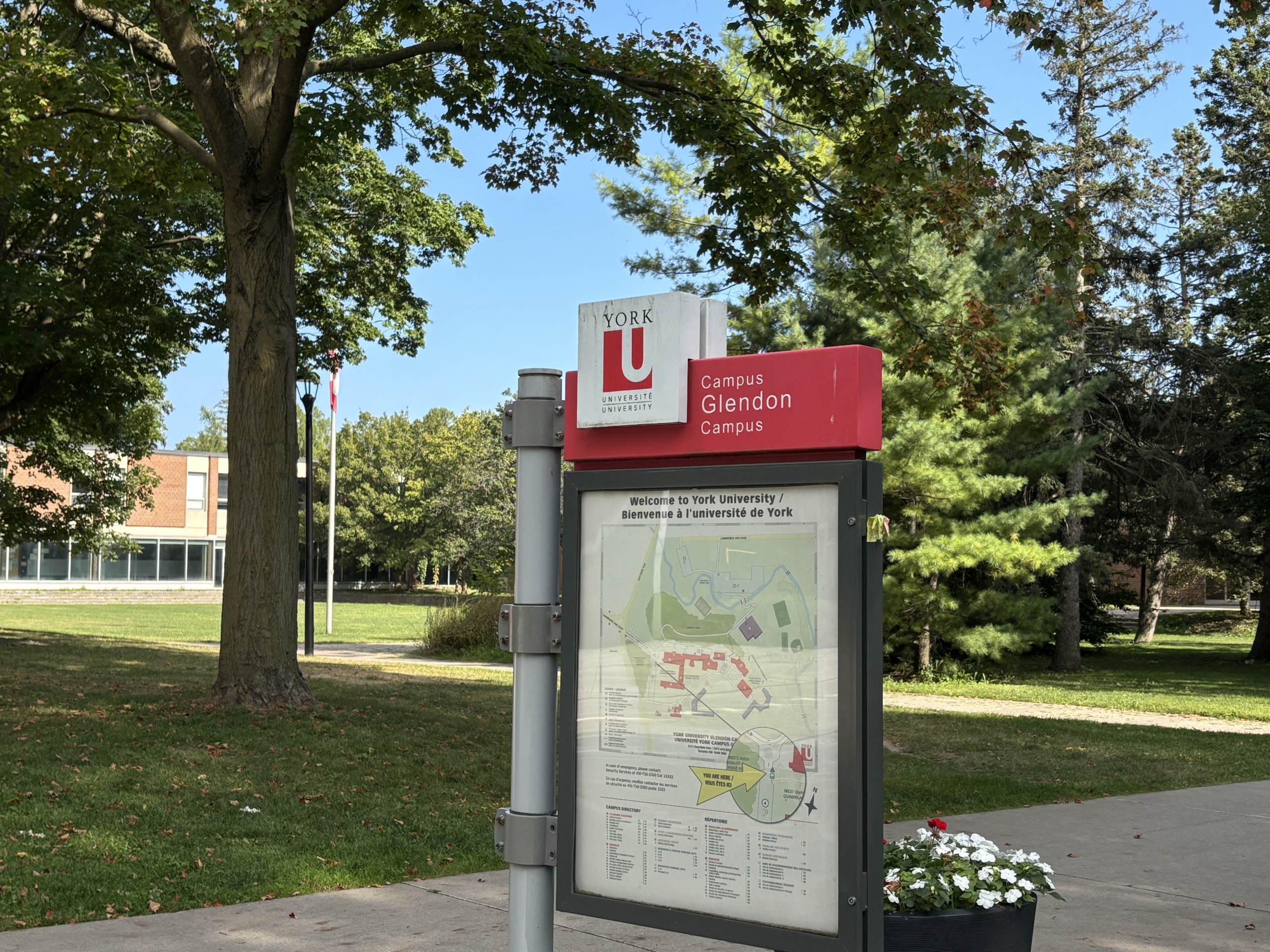
Like many Keele students, I used to think of Glendon merely as York’s “French” campus. But after taking several courses there over the past few years, I realized there was much more to it than that.
Glendon is one of York’s three campuses, operating as a faculty focused primarily on liberal arts education. Its defining feature is its bilingual mandate that brings Francophone, Anglophone, and multilingual students together in an environment where they can study in both French and English.
But Glendon’s purpose goes beyond offering courses in French. In the 1960s, its founders envisioned a bilingual and bicultural liberal arts institution that could help bridge Canada’s linguistic divide. That history remains visible today, with multilingualism, multiculturalism, and community central to the campus’ identity.
These characteristics matter now more than ever, because Glendon’s existence as a distinct part of York is currently being questioned.
A history of adapting
Glendon’s place within York has never been straightforward. The campus predates Keele, as York began operating at Glendon in 1961 in the University’s original form as a small liberal arts institution. When Keele opened in 1965, the two campuses were already envisioned to serve different purposes: Glendon for the liberal arts, and Keele as a larger, multi-faculty campus.
Glendon’s bilingual mandate has also evolved. The campus has adapted its language requirements over time, moving toward a more flexible model that allows students to enter without already being fully bilingual.
The campus’ physical history is just as significant. In 1950, Glendon Hall and its surrounding estate were bequeathed to the University of Toronto by financier Edward Rogers Wood and his wife Euphemia, with the intent it be used for educational purposes. The property was later transferred to York and became its founding campus. York recognizes Glendon as a cornerstone of Ontario’s educational heritage, recently commemorating its role in advancing bilingual education with a provincial plaque.
That heritage makes it difficult to separate concerns about the campus itself from those about Glendon’s future. If the academic community moves to Keele, what becomes of the estate’s original dedication? York says the land-use question is separate from the current academic proposal and that it remains committed to an academic presence at Glendon. What that ultimately looks like, however, is yet to be determined.
What York is proposing
York is considering transforming Glendon from a faculty into a university-wide college, and moving its bilingual academic offerings and French-language services to Keele.
Under the proposal, Glendon College would become the home for York’s pan-university French-language academic offerings, student services, and external relations. Programs offered at both campuses could be combined, while programs unique to Glendon could be transferred to other faculties at Keele. Faculty members would hold appointments in other faculties while retaining an affiliation with the new college.
According to York, the proposal addresses declining enrolment and financial pressures while creating more opportunities for students across the university to access French-language and bilingual education.
None of this has been finalized, and York has emphasized that the proposal is a starting point for discussion, not a decision or detailed implementation plan. Academic programming and student services at Glendon are continuing as usual.
The question hanging over many in the Glendon community, however, is not what York plans to move to Keele but what may be lost in the process.
What is York trying to retain?
York’s proposal is not presented as an attempt to end Glendon’s bilingual mission. The University says it wants to strengthen bilingual education and French-language services while making those opportunities available to more students across York.
But exactly how much of Glendon’s identity can be separated from the place and structure in which it has developed?
Glendon’s bilingualism exists within a particular academic environment. Students and professors interact across languages, while the campus’ smaller size allows relationships to develop differently than they might at Keele.
If Glendon can continue offering French courses and bilingual services from Keele, York may preserve parts of its formal mandate. Preserving the experience and community that have given that mandate meaning is a separate task altogether.
The people who study and work at Glendon have experienced that distinction firsthand.
What makes Glendon different?
Professor Usha Viswanathan, a French professor at Glendon, puts it plainly. “We’re not a French campus. We’re a bilingual campus,” she states. Most of Glendon’s students are Anglophone or Anglo-dominant, while Francophone students have access to French-language courses and services that are difficult to find elsewhere in Toronto.
That experience also exists outside the classroom. Glendon’s Salon francophone and Lunik Cooperative give students space to use the language and interact with other members of the community. Melissa Zahraei, a 2025 Glendon political science graduate now pursuing her studies at the University of Toronto, says the Salon made speaking French feel accessible rather than intimidating.
“They were actually so kind and so welcoming, and they made you feel so comfortable to speak to them in French,” she recalls.
Viswanathan also illustrates a French curriculum that goes beyond treating Parisian French as the sole standard by exposing students to Francophone communities in Canada and internationally, including African Francophone cultures. For students who cannot afford to study abroad or are unable to do so, Glendon provides another way to experience linguistic and cultural diversity in Toronto.
“We have a significant population that doesn’t have the means or the ability to travel,” explains Viswanathan, “and so they get that linguistic immersion here.”
The campus’ size is another part of that experience. Pradhi Kalra, a fourth-year psychology student, says she chose Glendon because she wanted a smaller community where she could get to know her classmates and professors.
“I felt like Glendon was a better place for me to transition from high school to university without feeling alienated from everybody,” she reflects.
Professor Radha Persaud, who has taught at Glendon for more than two decades and is a two-time recipient of Glendon’s Principal’s Teaching Excellence Awards, describes the same dynamic from the faculty side.
He points out that smaller departments allow students and professors to develop closer relationships, while faculty members from different departments also interact regularly. “That community life is probably quite unique,” he says. “And I think for the students, too, they enjoy the smaller classes, which allow for greater interaction with the professors.”
Persaud believes that this smaller environment has translated into tangible outcomes for his students. Over the years, he has seen Glendon students go on to institutions including Oxford, Harvard, Columbia, and the London School of Economics.
Shayan Zahrai experienced the differences firsthand. He studied political science at Glendon from 2012 to 2017 and also took courses at Keele, allowing him to make direct comparisons between the campuses. At Keele, he recalls large lectures where he did not think the professor even knew his name. At Glendon, professors knew him and had more time to engage with his work.
That familiarity also mattered to Zahrai as a student with a physical disability. Glendon’s smaller physical location made moving between classes more manageable, while personally knowing his professors helped him communicate his needs. At a campus the size of Keele, Zahrai explains, that kind of accessibility cannot simply be reproduced by adding the same services to a different building.
Persaud’s claim that Glendon’s smaller environment fosters successful students is echoed by Zahrai, who feels his experience gave him the confidence to pursue a bilingual education at the McGill Faculty of Law.
“Without Glendon, I definitely would not have felt confident enough to study law in French,” he said.
These experiences point to something larger than campus atmosphere. Glendon’s academic value comes partly from the way its size, bilingualism and liberal arts focus work together to prepare students for external opportunities.
Its role also extends beyond individual students. Persaud described Glendon as a “microcosm of Canadian society,” pointing to its multilingual and multicultural character. Viswanathan similarly emphasized that Glendon offers a linguistic environment that students cannot simply reproduce by taking a few French courses elsewhere at York.
Glendon’s value, then, is difficult to reduce to one feature. Its bilingual education is complemented by small classes, close relationships with professors, international connections, informal opportunities to speak French, and a physical campus where these aspects come together.
Is restructuring the only option?
There is no question that York is facing financial pressure. Government funding has declined, international enrolment has been restricted, and universities across Ontario are dealing with the resulting revenue losses. Glendon is experiencing those pressures alongside the rest of York. The University says that Glendon’s undergraduate enrolment has fallen by almost half over the past decade, from 2,645 students in 2016–2017 to 1,343 in 2025–2026.
Declining enrolment and reduced resources can reinforce one another, leaving Glendon with fewer course offerings, limited faculty renewal, and mounting deferred maintenance.
But there is another factor in that cycle: if students do not know Glendon exists, or understand it only as a “French campus,” it becomes harder to attract them in the first place.
Several Glendon community members argue that the answer should involve trying to grow Glendon, particularly by reaching students who have never considered it. That could mean greater recruitment in Francophone communities, more visibility among prospective students, and clearer communication about what makes a bilingual degree at Glendon different. Affordability is another consideration, particularly for students coming from outside Ontario and international students choosing among French-language universities.
The University has left the possibility for alternative solutions open. If the current proposal does not receive collegial support, “other proposals are welcome and will be assessed for their viability.”
What York chooses to preserve
Glendon’s future ultimately raises a question larger than whether one campus can balance its books. York says the goal of the proposal is to strengthen bilingual education, make French-language opportunities available to more students and build a sustainable future for the University’s bilingual mission.
The disagreement is over whether that mission can be strengthened by uprooting it from the place where it has developed for more than 60 years.
Glendon’s uniquely tight-knit culture is exactly why the proposal has been met with such a strong reaction. Students describe the meeting where it was presented as marked by “a sense of betrayal.” Alumni say they were “appalled” and see the possibility of losing the environment as “very sad” for future students seeking a York experience that is different from Keele’s.
These responses reflect how deeply Glendon is tied to its place within York. Its value comes from being small, bilingual, liberal arts-focused, and culturally distinct, while still belonging to a larger university. There is only one Glendon.
I firmly believe that York’s strength comes from the communities it brings together: different faculties, campuses, disciplines, and student experiences that are each distinct in their own right. Glendon is one of those communities, and its future matters beyond the physical location of its campus.
Though the University emphasizes that no final decision has been made, what happens next will show what York sees as worth preserving about itself.
