

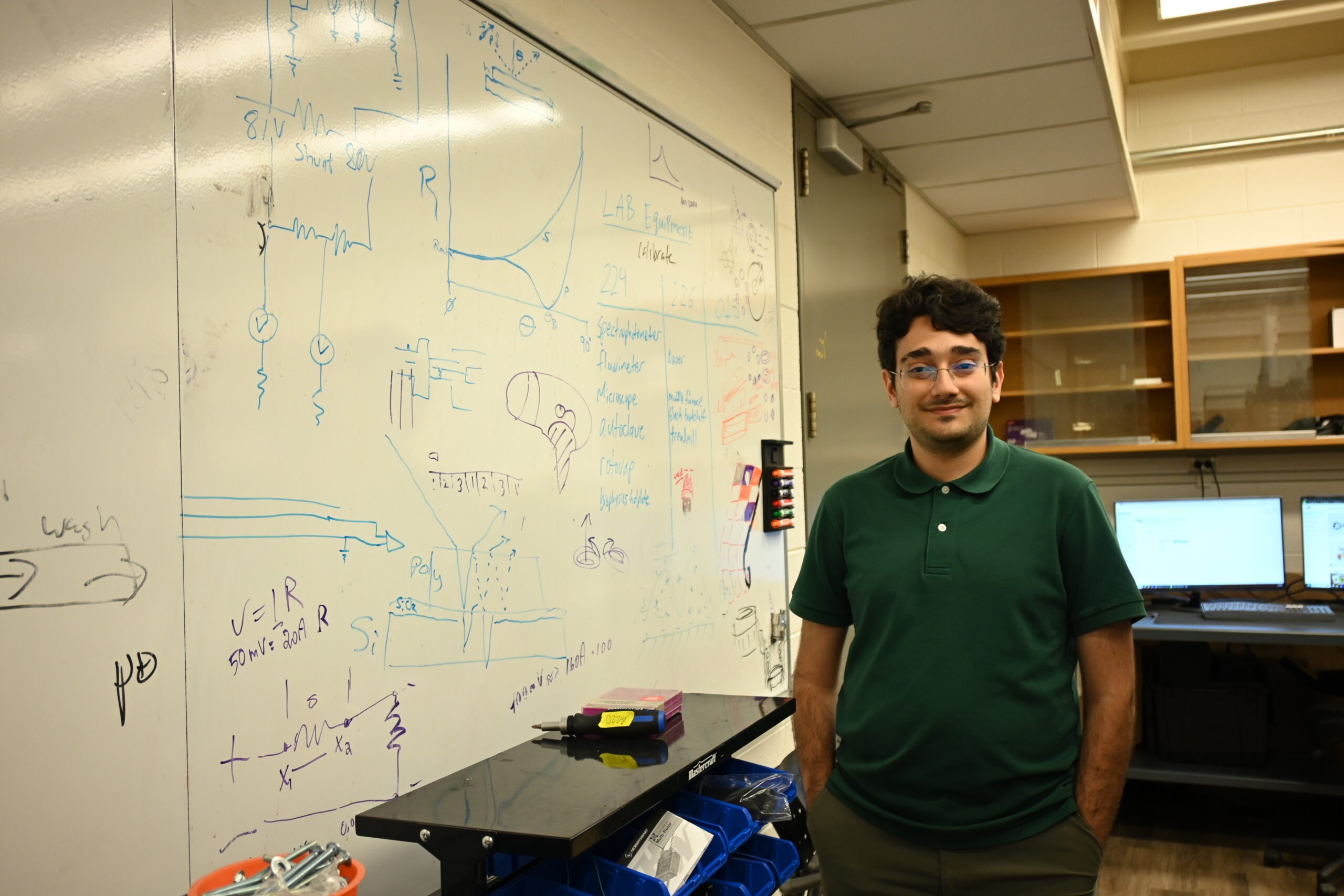
Shoot for the stars, and you might find recent graduate and 2026 Faculty of Science silver medallist Seyed Lari. Because when he’s not studying alien-like microbes at the Petrie Science and Engineering Building, he’s with York’s Arbalest Rocketry club, working on and launching student-engineered rockets in national competitions. And how did it all begin? A $50 homemade spectrometer, a serendipitous encounter, and enough curiosity and drive to fill, well, a rocket.
For Biology graduate Seyed, the tools and instruments of science were always his “driving factor.” He recalls feeling frustrated in his first-year courses, where he was taught the shapes and structures of “this molecule and that,” but not how those images or schematics were actually derived. “How did you figure that out? How do you know?” These questions burned in the young scientist’s mind.
And this is where he ventured off the beaten path. Rather than search for anything formal, Seyed took it upon himself to satisfy his own curiosities. Resourceful and driven by intense curiosity, Seyed set off to explore whatever his mind could envision, and his budget could allow. With $50 and a dream, he first built a UV spectrometer — a scientific instrument that measures and separates wavelengths of light — from an iPhone and cardboard. “And that was really the start of research for me,” he recalls.
Around that time, Seyed completed his second year and, following a stimulating experience in introductory organic chemistry, joined the lab of his professor, Dr. Arturo Orellana. He worked with Dr. Orellana that summer, continuing with him throughout his third year. He describes Orellana as a “really open supervisor.” He fondly recalls, “Any crazy idea I had, he would always support it. I think he was the first person who really believed in me.” Seyed speaks about how the confidence and support he gained from Dr. Orellana followed him throughout his research career.
The core of his research experience, however, was with Dr. Ozzy Mermut at the MiBAR Lab (Mermut Integrated Biophotonics Applied Research). While Seyed genuinely enjoyed his research with Dr. Orellana, he was missing the component of instrumentation and tool-building which had always fascinated him. “I realized that biophysics, and physics in general, was the way to go to design instruments.”
A testament to his passion for independence and initiative, Seyed was once walking past Dr. Mermut’s office in the summer of his third year, one of his homemade devices in hand, when Dr. Mermut asked him what he was carrying. Upon hearing his answer, she simply responded, “This is cool. You’ve got to come to my lab.”
That was how his most formative research experience began. On his first day with Dr. Mermut, Seyed spent an entire day looking under a microscope at a mysterious type of algae cells he describes as “alien-like,” Pyrocystis fusiformis. They are large, single-celled organisms with unique shapes and glow-in-the-dark properties, known as bioluminescence. After a day of observing, Dr. Mermut turned to Seyed and said, “You see that? We’re going to build an instrument to study its properties.” It is no wonder that Seyed says he thoroughly enjoyed his first day.
He spent the next year or so building instruments, designing studies, and getting the resources and support to investigate all the curiosities that had found a home in his mind. He presented his work at multiple conferences — most recently the Canadian Association of Physicists — won many awards, and most importantly, had “lots of fun” along the way.
Seyed shares the biggest adjustment he has had to navigate in research environments. “I think by far, the biggest challenge is thinking for yourself as opposed to having data just given to you.” Another challenge he struggled with was “staying on top of things and [staying] focused on one thing.” For a man with such curiosity and passion, the slower demands of research can often take a toll. “I get too excited about the things I work on,” he relates. “I get bored easily if a project takes six months to do. It might be exciting at first, but to actually do something, it takes time.”
Alongside his love of building scientific instruments and studying alien-like algae, Seyed also found great fulfillment through York’s rocketry club, Arbalest Rocketry. True to his penchant for initiative, Seyed had the idea of putting the algae he was studying onto the rocket that the club was planning to launch into the atmosphere.
When he pitched the idea to Dr. Mermut, she was so excited that she offered to fund the club and sponsor its rocket-building efforts. “She was like, ‘I want to get involved. I want to give you guys money.’ That was it.”
And this openness is one of Seyed’s favourite things about Dr. Mermut and the way she runs her lab. “You can be an undergrad, grad student, whatever — everyone listens to you. Everyone really matters in that sense,” he explains. “And that actually leads to her lab having a lot of, I would say, accidental discoveries. Because everyone just throws out random ideas that they’re really passionate about. And it works out.”
After working on their rocket for two years with a team of 50 engineers and researchers, Seyed is proud to share that York’s Arbalest Rocketry placed third at the recent national Launch Canada event. Their rocket was recognized for its engineering, as well as the innovative research on the response of Seyed’s glow-in-the-dark algae to the extreme conditions encountered during launch.
“Doing science experiments on rockets, there’s nothing that beats it,” Seyed happily exclaims.
Outside of the lab, when he’s not building instruments, Seyed enjoys microscopy, where he collects samples of anything interesting he finds in nature and takes microscopic pictures. As he reiterates, “I’m the type of guy that I just have to see things to learn them.” So he “went and spent some money buying a microscope” in his first year, and has been exploring the microscopic world ever since. He’s also a big fan of kayaking and enjoys trips to the beach.
As for the future, Seyed doesn’t have a strict path to follow. He is contemplating a gap year while letting his passions and curiosities guide his next steps. “I want to do more rocketry. And microscopes…definitely a dichotomy there,” he laughs, “but I think I can make it work.”
In the long term, he knows he wants to be a scientist. “I love what I do,” he says.
When offering advice to aspiring scientists, Seyed emphasizes, “You don’t want to join a lab that you have no interest in. Interest drives you as a researcher.” True to his independent nature, he also advises starting with things “you’re actually interested in without being in a lab.” If there is one takeaway he can end with, it is to repeatedly encourage the pursuit of self-directed projects and cultivating your own curiosity and development. The goal is to find your own path, wherever that may lead you.
“Do fun things with science, and people will notice. Your talent will not go wasted.”
For more information about Dr. Mermut’s research at the MiBAR Lab, check out her lab website here.
Which York scientist do you want featured next on The Petrie Dish? Email editor@excal.on.ca, or message @talesfromexcalibur on Instagram!
