

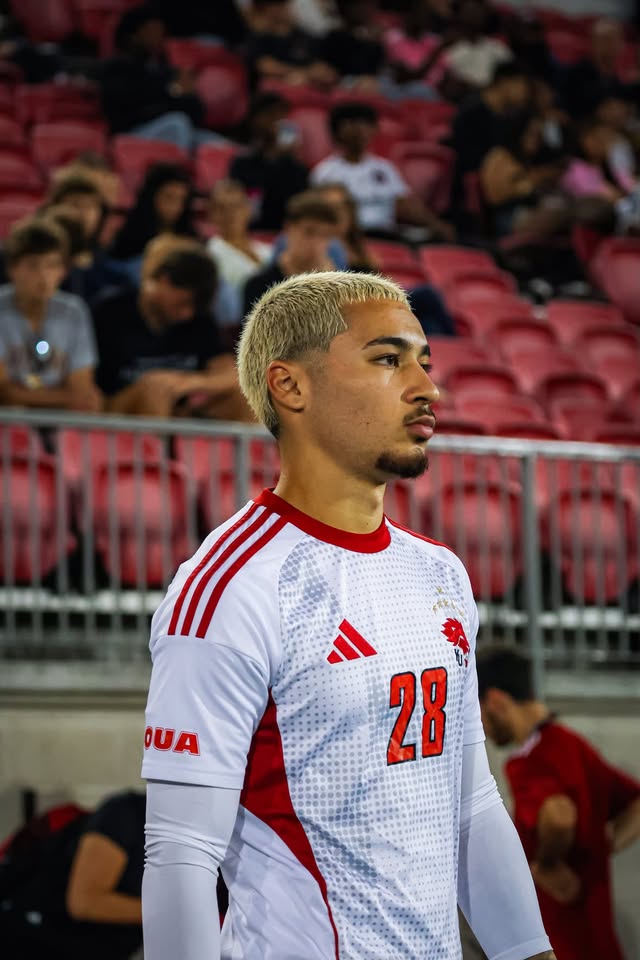
For Matthew Fischer, soccer has been a constant since childhood. From playing for local clubs in North York to representing Ontario and even competing in the United States, his path in the sport has taken him through several stages of development. Now part of York’s men’s soccer program, Fischer is focused on making the most of his university career while preparing for life beyond the pitch.
Fischer’s journey began early, playing organized soccer at around six years old with a local club called Power Soccer. He later joined Dutch Connections in Scarborough, before making Ontario’s provincial team at 14, where he competed against Quebec. His performances eventually caught the attention of Toronto FC’s academy, where he played throughout high school at Earl Haig Secondary School.
After graduating, Fischer headed south to Buffalo, New York’s Canisius University. He spent one semester there before deciding it was not the right fit, and transferred to York in the winter of 2024. Initially, he arrived intending to focus on his studies rather than play varsity soccer. That changed during the summer, when his off-season trainer —a former York player who maintained connections with the coaching staff— helped him explore the possibility of joining the team.
“I was like, put in a word for me… and see what they say,” Fischer recalls. “And then it just kind of happened.”
Fischer’s time with York has included competing for conference and national honours. After the 2024 season, he was selected by York United FC in the second round of the 2025 Canadian Premier League–U SPORTS Draft. He scored the extra-time winner in York’s 2024 OUA semifinal and helped the Lions earn a U SPORTS bronze medal that season. In 2025, he contributed to the Lions’ national championship campaign and was named a U SPORTS championship all-star.
Beyond his work on the pitch, Fischer studies kinesiology and health science while balancing training, matches and academic deadlines. During the season, he estimates that most of his available time goes toward studying or completing assignments. Even Fischer’s commute from North York becomes an opportunity to get schoolwork done. “Whatever time you got, you just got to make use of it,” he says.
His experience playing in Toronto FC’s academy while attending a regular high school helped prepare him for the demands of university athletics. Rather than struggling to adjust to the workload, Fischer says he carried forward the study habits and discipline he had developed earlier.
Fischer credits his progress to the people who have supported him along the way, including his parents, coaches and trainers, and he emphasizes that “it’s definitely a collective effort.”
That collective support has helped Fischer maintain his focus as York looks toward another postseason run. He believes the team’s returning core has contributed to its strong start, while acknowledging that dropped points have exposed details the Lions still need to improve. With two regular-season games remaining at the time of the interview, Fischer says the priority is to keep improving rather than get ahead of the team’s championship ambitions.
“I don’t tend to look towards that,” Fischer says of U SPORTS nationals. “I just kind of try to focus on each game.”
Fischer has another year of eligibility remaining after transferring, giving him additional time to pursue his soccer ambitions. Beyond the pitch, he hopes to work with his trainer and eventually train athletes himself, drawing on the methods that have shaped his own development. For now, he is keeping both goals in view: continuing to compete at the highest level available to him and building a career that can last beyond his playing days.
