
Victoria Silman | Assistant News Editor
Featured image courtesy of James Jiraphanumes
According to York’s mission statement, the university tends to define itself as a progressive institution with “academic freedom,” and a focus on “social justice and collegial self-governance.” Within this, the university has managed to develop a reputation for being highly active due to a population of students who are politically involved in key issues within the community.
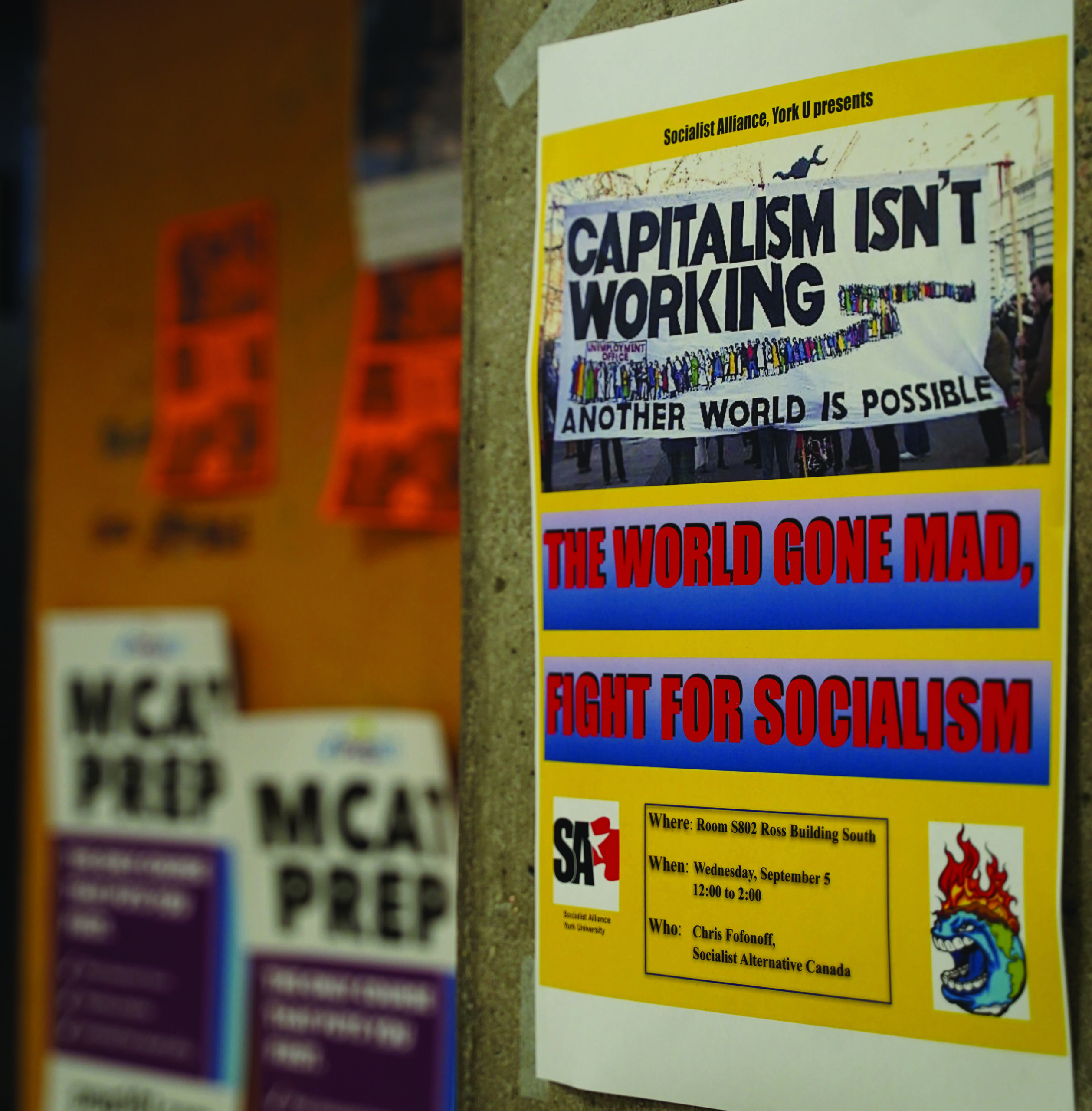
With posters plastered on the walls advocating for free speech, or fighting against capitalism, there is an aura of political activism encompassing York.
However, there remains discrepancies between political knowledge and the student population—though it is possible that this is the result of a lack of media coverage and advertisement, or oversaturation of certain political issues.
Political dilemmas of the utmost importance currently affecting students on campus, there are many aspects of politics students should be aware of.
Beginning with York, political involvement helps to determine how students experience their four (or five, or six) years of university education. The York Federation of Students (YFS) is the student union run by five elected individuals: Rawan Habib as President; Sebastien Lalonde as Vice-President (VP) Campaigns and Advocacy; Anthony Fernandes as VP Campus Life; Jordan Madeira as VP Operations; and Aminat Arigbabu as VP Equity.
Posters around the university tend to advertise for events, however many students are still unclear of who YFS is or what they do, as there is little information provided outside of their website.
Second-year English and professional writing student, Latavia Ferguson, explains: “If I’m not mistaken, they’re basically taking care of student needs.
“I do believe last year they wanted to be able to make transit easier and have our York cards for that instead.”
YFS is significantly involved in student matters, including the decision to strike down the U-Pass presented as a possible option for cheaper transit for students. Furthermore, YFS also oversees health and dental insurance, student clubs, and YorkFest—to name a few.
The YFS elections are held in second semester, with ballot stations spread throughout campus. The entire period between candidate nominations, campaigning, and the electoral process takes approximately a month between January and February.
With the strike being a major factor during the provincial election in June, many students remained in the dark in regards to key issues affecting the strike, a characteristic causing frustration for Jake Vanderkooy, a professor within the political science department at Glendon.
“I never really sensed that students had a real understanding and/or interest in understanding the dispute during the strike. Yet this was a labour dispute that should’ve been of interest to everyone involved—especially students! I was more than willing to elaborate the positions of both sides in this dispute. Alas, no one seemed to care,” he says.
Voters in the election also tended to vote in favour of ending the strike, however there are other factors at play with those who voted in the election. Despite not wanting newly-elected Premier Doug Ford to win, some voters on campus still feel the outcome was in their favour, as back-to-work legislation was passed, reversing strike action and bringing students back to the lecture halls.
“I was kind of upset because I don’t like what Doug Ford as a person stands for or what he’s planning to do,” explains Rimita Baruh, a second year English and professional writing student.
“At least this cancelled the strike. I thought: ‘Yes! I can finally go back to school,’” Baruh continues.
In terms of voting, students present an unawareness to specific candidates and platforms, though they agree that further research should be done before the next election.
“I voted for the Liberal party,” says Baruh. “It was my first time voting, so I was kind of unsure at first. I know next time I should do more research. I heard good things about this party, so that’s why I voted for them,” she explains.
Students do, however, know the key issues happening in government, including Ford’s bill to reduce the size of city council by half.
“Doug Ford was trying to shrink the size of city council, and reduce the number seats from 47 to 25,” states Ferguson.
In relation to the provincial election, however, there are students who shed light on the importance of voting and understanding why individuals vote for certain candidates.
Celia Lewin, a third-year biomedical science student, is an active participant in politics within the community. “I did vote in the provincial election. I supported MPP Gila Martow, who represents the Progressive Conservative (PC) party,” she explains. “I voted for her because I believe she did a great job in her last term and deserved to be re-elected. As well, I wanted to see a change in the leadership of our province. I want more fiscal responsibility and increased efficiency in our government.”
Federally, students are still blind to what is happening, who is representing which parties, and when the election will actually occur.
Baruh explains: “I feel like I don’t know that much about Canadian politics specifically, compared to the US.”
The federal election will occur on October 21, 2019. The candidates for leader of Canada are as follows: Prime Minister Justin Trudeau will run for his second term as PM for the Liberals; Andrew Scheer represents the PC; Jagmeet Singh is running for the New Democratic Party (NDP); Elizabeth May continues to run as the Green Party Leader; and Mario Beaulieu is running as the interim leader for the Bloc Québécois.
A lack of political knowledge on the Canadian front has been attributed many times to an oversaturation of certain global political issues in the media. Ferguson explains: “We hear more about what’s happening in the US than we do here, so I’m not fully familiar with all of the parties and what they represent, except the roles and all that stuff you hear on the news.”
“Everyone talks about what Donald Trump is doing, it’s everywhere,” she continues.
Certainly Trump has dominated the media since he began his presidency almost two years ago, however students should be aware of what is occurring in their political climate.
Lewin, who recently created the petition to call for integrated fare between YRT and TTC, demonstrates that it is possible to become involved in politics at any time. “I had no political involvement until March of this year,” she says.
“My political activism has been the most meaningful volunteer work I have ever done. Being in politics means finding problems and formulating a plan of action to implement a solution. People are taking notice of what is going on and I think that is really important,” she continues.
Getting involved is as simple as following the news. “I start off my day by reading the news from various sources. I scout my Facebook feed looking for anything of interest that my friends or groups have posted,” Lewin explains.
Students are encouraged to take greater interest in political affairs, but also to seek alternative views. “Read editorials, and most important of all—try to understand your adversary’s position,” Vanderkooy emphasizes.
Further frustrating for Vanderkooy is the common tendency to act against opposing views— something often seen on campus.
He states: “Students are a bit too susceptible to prevailing cultural and political notions of ‘groupthink’ (although, fortunately, there are exceptions). Examining the views of those whom one disagrees with would be very refreshing!”
