
We may be witnessing the beginning of a new space renaissance.
The Artemis mission has reignited humanity’s ambitions in space, pushing the boundaries of human spaceflight and inspiring a new generation of space enthusiasts. For me, it has sparked an unexpected curiosity: astrobiology.
Space exploration has traditionally been the domain of physicists, engineers and astronomers. But as we venture further into the cosmos, biology may prove just as important.
For decades, unforgiving environments have constrained space exploration beyond Earth. Extreme temperatures, radiation, limited resources and the physical toll of long-duration spaceflight have made exploring distant worlds a formidable challenge. However, advances in artificial intelligence, robotics and autonomous systems are beginning to change the equation.
Unlike humans, robots don’t age, need food or experience the same biological effects of prolonged radiation exposure. They can also be designed to withstand hostile environments that would be dangerous for astronauts.
Perhaps the question is no longer whether humanity will attempt to establish a presence on another planet, but when. From understanding how organisms survive in extreme environments to exploring ways of adapting biological systems for life beyond Earth, the possibilities are fascinating.
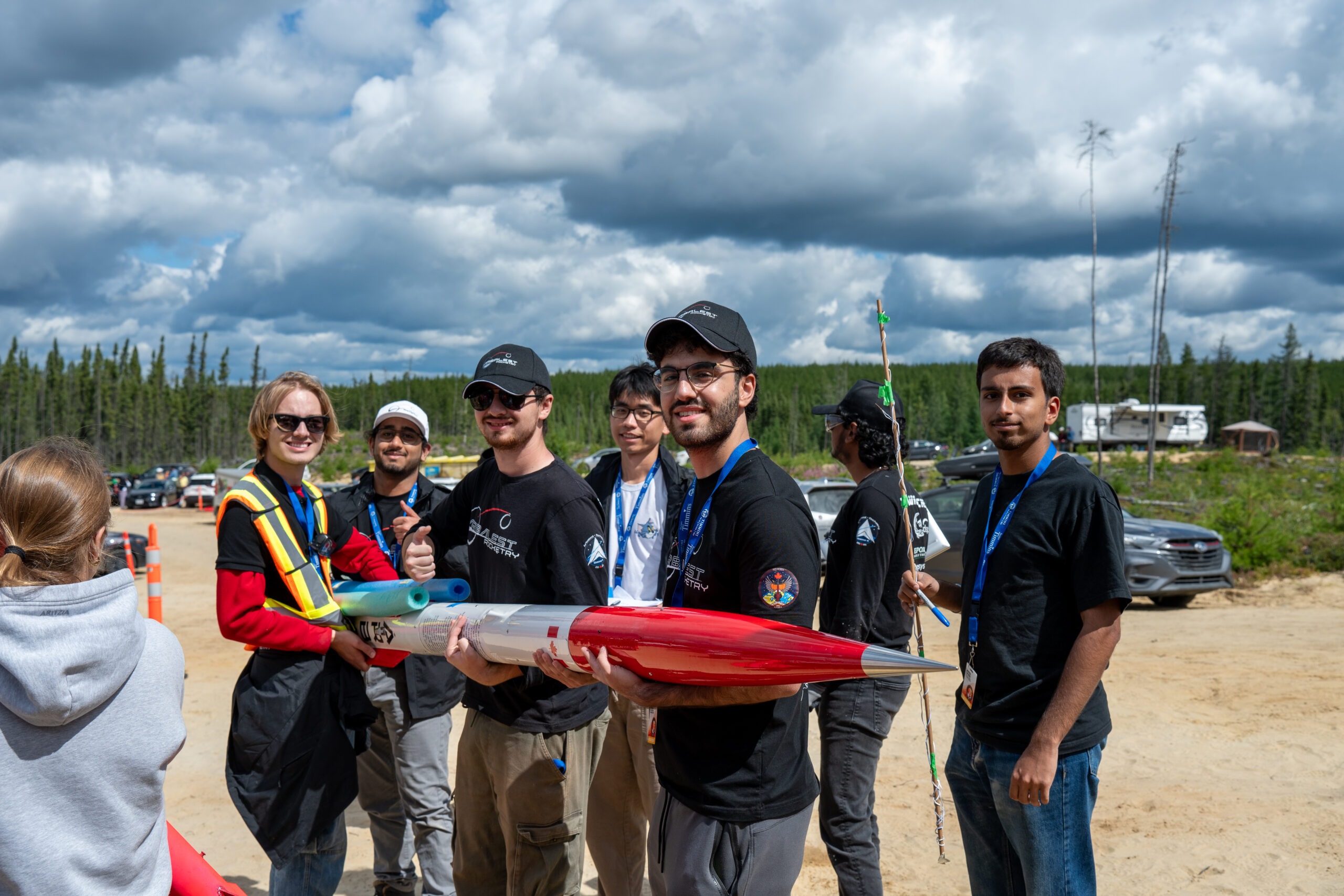
With these thoughts occupying my mind, I decided to explore some of the exciting work happening closer to home. I met with Seyed Masoumi Lari, who heads the biology payload section of York University’s very own rocketry team, Arbalest Rocketry, and is currently working on the team’s latest rocket, Red Robin.
From a high school idea to a university rocketry team
Arbalest Rocketry began at Turner Fenton High School in Brampton. A small group of students developed an interest in rocketry. What started as a student initiative has since evolved into a full-fledged, 50-person team at the Lassonde School of Engineering.
Today, the team’s mission is to give students hands-on, industry-level experience by designing, building and launching high-powered rockets, while nurturing the next generation of engineers and innovators.
Meet Red Robin: York’s high-powered rocket
Currently on display at Bethune College, Red Robin is an impressive example of what student engineering teams can accomplish.
The rocket boasts a maximum speed of Mach 1.3, an altitude capability of 20,000 feet and three-axis control. With a custom-built computer, plus a government-issued motor and fuel, Red Robin seems invaluable. Lari, however, is happy to put a price tag on it for readers. “If you were to sell the rocket at auction,” he says, “you would be able to buy a car with [the money]. It cost $30,000.”
As an excited Seyed begins explaining the technical specifications, he enthusiastically introduces me to the fundamentals: “Yaw, pitch, and roll!”
But Red Robin isn’t just about impressive engineering specifications. It also carries something particularly exciting for someone studying biology: a scientific payload.
When biology gets on board a rocket
One of the most interesting aspects of Red Robin was its biology payload, one of three experiments inside the rocket. “We flew an algal experiment,” Lari explains, investigating its response to light under different gravitational conditions.
The observation was fascinating: in microgravity, the algae moved towards the light, while under normal gravity conditions, they moved away from it. Why this discovery occurs, says Lari, “we don’t know yet. We’re still figuring it out.
Experiments like these offer a glimpse into how living organisms respond to changes in their environment. Understanding how gravity influences biological processes could become increasingly important as we venture further into space and investigate whether life can adapt to conditions beyond Earth. “The majority of applications are in the medical field,” Lari states.
The payload experiment is directly related to some of the most exciting developments in modern medical research: optogenetics. Light-sensitive proteins discovered in single-celled algae helped scientists develop techniques to control nerve-cell activity using light, a discovery recognised by the 2026 Nobel Prize in Physiology or Medicine.
For a Biology student, seeing an experiment involving living organisms travelling aboard a rocket is a reminder that space exploration isn’t just about engineering machines to reach distant worlds.
A podium finish at Launch Canada
Red Robin was launched in Timmins, Ontario, during the Launch Canada competition, a national event that brings together university rocketry teams from across the country.
The competition had an especially memorable moment when Canadian astronaut Chris Hadfield performed the countdown for the rocket launch. Having one of Canada’s most celebrated astronauts involved in the launch made the occasion even more special for the student teams and aspiring space explorers in attendance.
With approximately 30 universities participating, York University’s Arbalest Rocketry secured an impressive second-place finish in both the design and payload categories.
What’s next for Arbalest?
With a team of approximately 50 members, Arbalest Rocketry is led by president Eric Das, with Ronik Jagdev serving as lead designer. Seyed Masoumi Lari heads the biology payload section.
Arbalest’s current projects include the Moose rocket series, marking its transition from solid-fuel to liquid-fuel rockets, and exploring research opportunities with the European Space Agency (ESA).
The team is also seeking sponsors and industry partners to support future projects. Although active recruitment has ended, students of all backgrounds are welcome to get involved. “We don’t care about how much experience you have,” says Lari. “We just care about how dedicated you can be.”
From a handful of high school students fascinated by rockets to a massive university team competing on the national stage, Arbalest is a reminder of what curiosity, collaboration and a little ambition can achieve.
