
Ontario has a lengthy history of underfunded post-secondary schools. While public funding in the 1980s averaged about 80 per cent of university operating revenue, this portion more than halved to just 36 per cent by 2001. In the 2010s, government officials and university administrators began referring to Ontario’s public universities as publicly “assisted” or “supported,” and by 2022, government funding dipped to under 25 per cent.
According to the Financial Accountability Office of Ontario’s 2025 Spending Plan, the province ranks the lowest in Canada for per-student funding of post-secondary education. In 2022-23, Ontario was more than $5000 below the national average for funding of both public colleges and universities. The three-year budget plan for 2025 to 2028 projected an overall decrease in government spending on post-secondary education, all while the cost of living rises. As CFS Ontario (CFS-O) national executive representative Omar Mousa puts it, “students are being priced out of their own education system.”
CFS-O launched the Hands Off Our Education campaign in Oct. 2025 as a response to the provincial government’s introduction of Bill 33. Framed as cost-saving changes, the act most notably increases government oversight on post-secondary institutions’ admission criteria and ancillary fees. The movement expanded further to combat Premier Doug Ford’s end to the seven-year provincial tuition freeze and cuts to OSAP funding amounts, with a major day of action held outside of Queen’s Park in March 2026.
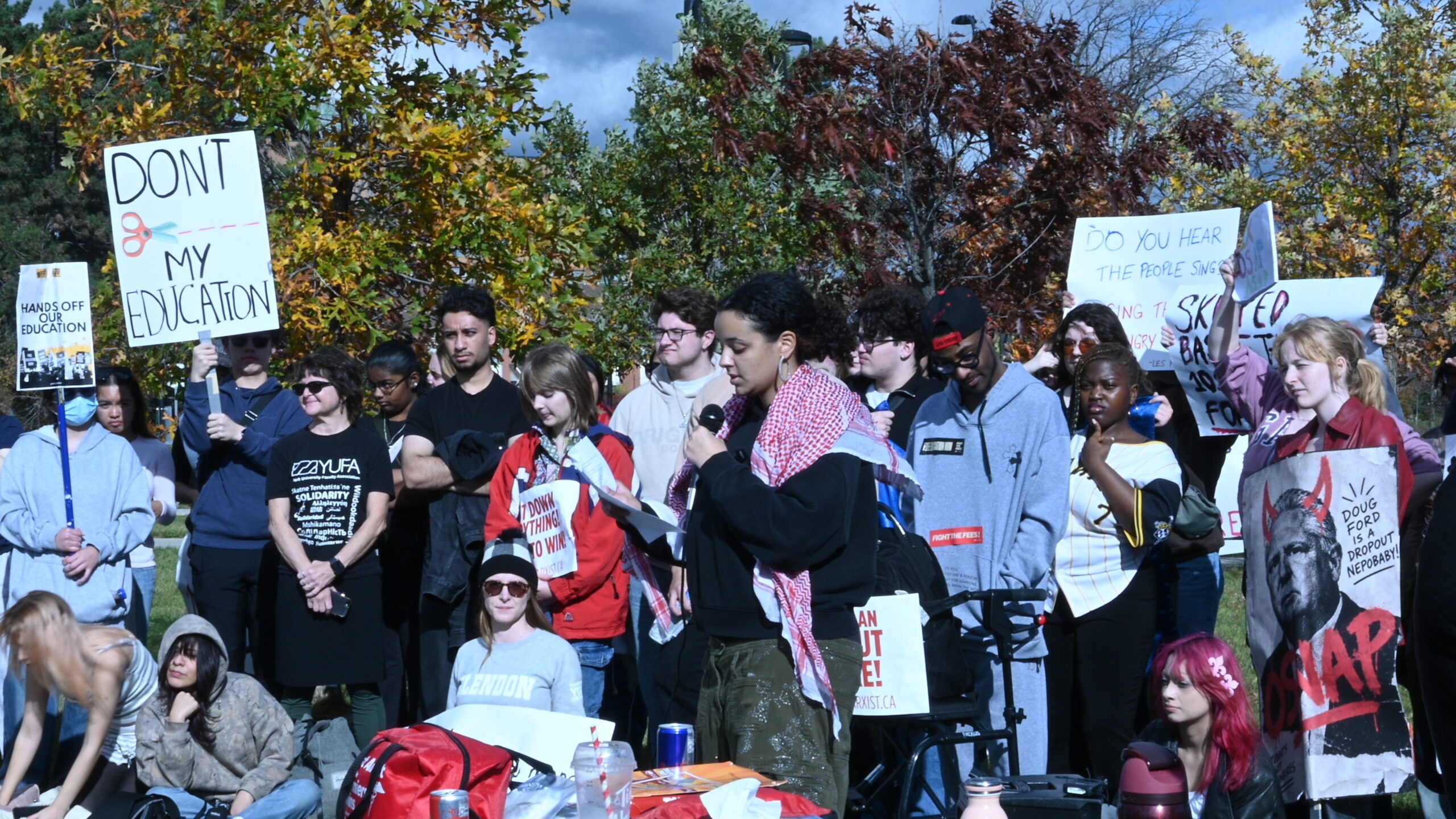
On Nov. 5, just over a year after Hands Off! began, students at York and across the province held a one-day strike to protest these austerity measures. 17 of the 21 Ontario post-secondary schools that have student unions affiliated with CFS-O staged walkouts.
Rather than a central location, the day’s demonstrations were at individual campuses. Mousa explains that the rationale was to encourage wider participation. “Doug Ford cannot ignore us when our student movement is active across the province.”
York’s walkout began at 9 a.m. in Vari Hall, where YFS VP campaigns Farida Fouad and other picket captains led rallying chants. Fouad gave a short speech and then led the protesters outside to picket behind York University station.
On the picket line, Excalibur spoke with second-year sociology major Paige Margraf about how the funding cuts have made it challenging to obtain her accessibility accommodations. “Part of the process of attaining my accommodation, which is ergonomic chairs in my classrooms, is that Facilities has to place the chairs and lock them up,” Margraf explains. Getting these chairs set up for her has been “very difficult, because Facilities is currently understaffed.”
Facilities Services, which encompasses the management of York’s utilities, custodial services, and maintenance, is just one department in what York calls the Shared Services category of its “core operating activities.” As Margraf puts it, “Shared Services are what run our school.” Campus Planning, Design & Construction, also a part of Shared Services, is responsible for deferred maintenance, for which York has racked up hundreds of millions in repair costs.
Even if you ignore its leaky ceilings, the University’s financial struggles are apparent. The Markham campus lost provincial funding to the tune of $125 million – nearly half of the project’s construction budget – after Ford’s election in 2018. The suspension of admissions to 18 humanities programs in 2024 and proposed move of Glendon’s academic offerings to Keele serve as more recent examples. York’s operational deficit has been looming for years, and the gap in government support created an opening for private consulting firm Nous Group to offer austerity as a solution.
Nous signed a three-year, $7.8 million contract with York in 2020 and worked to create the University Services Centre (USC), which centralized staff services like recruitment, payroll, purchasing approvals, and IT. Previously managed by faculty-specific employees, the USC introduced an online portal and ticketing systems for each area of service. In an interview with The Breach from July 2026, former YUFA president Ellie Perkins stated that the change “represents a loss of institutional knowledge and…the human relationships that help universities function effectively.”
In York’s most recent Multi-Year Budget Plan, the administration says they plan to commit a total of $40.9 million between 2025 and 2028 “to achieve significant operational savings” by further reducing Shared Services budgets. To Margraf, this decision spells certain doom – not just for herself, but for all members of the York community. “I want the government to provide more funding to universities, so York doesn’t have to cut services that are essential.”
The walkout’s press conference began at noon, opening with remarks from YFS president Symone Lennon and featuring speakers from York’s colleges and student organizations, as well as staff and faculty unions.
David Dharma, Faculty of Education Student’s Association (FESA) president and second-year BEd student, was one such representative. Catching up after his speech, Dharma admits that he “would rather not be here.” But in his eyes, “the constant overreaches by the Ford government have made it important for me to step out of my classes and show my support for this movement.”
Dharma is soon to graduate and has been doing in-person school placements, where the impact of the OSAP cuts is evident. “I’ve seen so many promising students that are in Grade 11 and 12 voice uncertainties about their futures,” he says.
Beyond worries of OSAP, the Ford government has been making its presence known throughout aspects of primary and secondary education. Bill 33 requires that “[school boards] work with local police services to provide them with access to school premises” and reintroduces the controversial resource officer program. In March, Minister of Education Paul Calandra replaced the school board trustee-appointed position of director of education with the minister-appointed chief executive officer. Calandra followed this up with a now-rescinded plan to delay the swearing-in of elected trustees in Toronto and seven other district school boards, just days before Ontario’s municipal elections.
“The reason that anybody gets into education is for students, and the thing that these changes impact the most is them,” says Dharma. “That’s the real meat of this for me, that this administration is targeting children, students, the least privileged people within our society.”
The provincial government consistently provides the same justification for these changes: more institutional transparency, and less taxpayer dollars being wasted. From an administration facing yet another scandal, this one about sending OSAP funds to fraudulent private career colleges, these words build little confidence.
According to the Canadian Press, Minister of Colleges, Universities, Research Excellence and Security (MCURES) Nolan Quinn was notified as early as 2023 of suspicious activity among three schools under the Academy of Learning Franchise. For two of these private post-secondary schools, more than half of their 12,000 OSAP applications from 2025 originated from a single IP address.
To a York employee and graduate student who requested anonymity, Ford’s multi-pronged power grabs and egregious fumbles are increasing collective awareness. “That’s the level of austerity that this government has reached,” they explain. “We’re at the point where a lot of people are fighting the same dragon.”
Brian Truong, an organizer for York’s Revolutionary Communist Party branch, hopes the student movement can gain traction and extend to Ontario’s workers as well. “One day is not going to force Doug Ford to listen to us,” states Truong. “What’s really going to hurt them is if the workers go on strike.” Truong views the walkout as “a great first step” on the part of the YFS but says “it cannot end here.”
Larissa Li, who spoke as an ambassador for the York chapter of Students Against Austerity (SAA) and the Palestine Solidarity Collective (PSC), agrees. “There is a need for grassroots organizations to also start taking the head, and for students to have more of a say in the planning, vocalizing, and tactics that are used.” Li also mentions the need for divestment from Israeli institutions, currently unmentioned by the Hands Off! campaign, to be a democratically selected demand for a wider student strike.
Li encourages students to continue to get involved “on a material level,” and recommends those interested in organizing follow @tostudentsagainstausterity, @ontariostudentstrike, and @psc_yorku on Instagram. The SAA’s York chapter is currently planning town halls and open meetings, and PSC will be launching campaigns in the coming weeks. “We want to hear student input, and we want students to…understand that this is their movement,” she says.
Lennon echoes these sentiments, stating that “this can’t be a YFS initiative. This has to be a bottom-up type of organizing if we actually want to win.” The Federation made significant efforts to engage the York community, garnering endorsements from over 120 student and campus groups, as well as securing academic amnesty from the York Senate. The next major student mobilization is currently planned to be an unlimited strike during the winter semester. In the meantime, Lennon and her fellow executives are committed to “attending any [club initiative] that’s related to organizing…against these OSAP cuts, because we understand that this is what solidarity looks like. We show up for each other.”
