

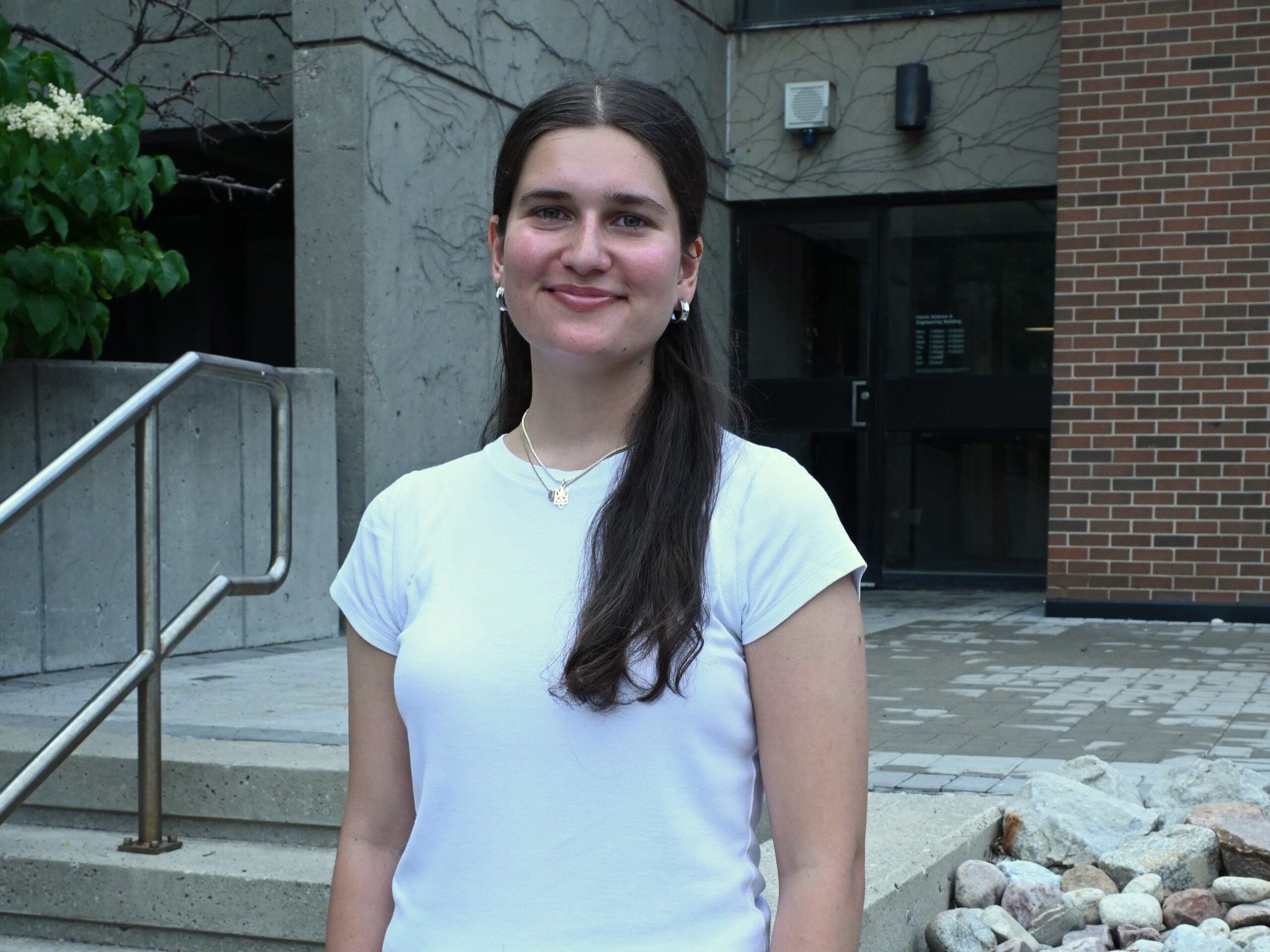
Mind full of wonder, heart full of passion, and hands full with vials of antibodies, immunology aficionado Sophia Luzskov graces The Petrie Dish as the third student researcher in this series profiling York’s finest student-scientists.
Ukrainian by blood and Canadian by land, Sophia describes herself as a “forever student” and a “born learner.” Having graduated this June from her honours degree in Biomedical Science, she looks back fondly on her journey through undergraduate studies, and her eclectic experiences with science and research.
Sophia chose Biomedical Science because she knew she was interested in medical research early on. “I wanted to be a researcher,” she recalls matter-of-factly. And research she did. Right after the summer following her first year, Sophia started a research practicum under Dr. Yi Sheng, a structural biologist whose lab is devoted to understanding how certain molecular proteins and pathways contribute to the development of cancers, immune disorders, and neurodegenerative diseases. This lasted two semesters — first in the summer of 2023, and second in winter 2024.
Then, the summer after her second year, Sophia switched gears for a brief stint in pedagogy under Drs. Tamara Kelly and Tanya Da Sylva, two York biologists with a strong passion for improving learning in undergraduate classrooms. Sophia worked with them for one semester as a RAY (Research at York) student, which is a paid position designed to provide undergraduates with valuable research experience at competitive salaries.
In a third twist of fate, Sophia found herself in yet another research practicum, this time with Dr. Yuqing Feng, who joined York in 2024 as one of the university’s only immunologists. It was Dr. Feng with whom Sophia ultimately completed her honours thesis in the following year, wrapping up a degree filled with unique research experiences and thrilling learning opportunities.
For her thesis project, Sophia worked with Dr. Feng and a graduate student to study “the molecular details of how the adaptor protein FAM72A is involved in inducing class-switch recombination and somatic hypermutation during B-cell development.” In other words, she studied a protein involved in building parts of the immune system. Obviously.
So what drew Sophia toward this path? “In high school,” she recalls, “I remember I liked that science was very logical.” In a world with “a lot of misinformation,” Sophia felt naturally inclined toward the “empirical evidence” upon which science relies.
But science is as vast as it is captivating, and took Sophia a few years and three research experiences before she found her true passions. In the beginning of her degree, Sophia felt like she was “interested in everything,” and this feeling continued into third year, where it slowly morphed into feelings of anxiety. She had known by then that she wanted to pursue a master’s degree, but despite her two past research experiences, she still hadn’t found what she was truly passionate about.
Then she took BIOL3120: Immunobiology. “It was the first time in my life where I was like: this is it. This is what I want to focus on.” Whatever it was about that class that sparked her innermost curiosities, she knew she “wanted to get involved in an immunology lab at York.”
Determined to explore the field further, Sophia approached her immunology professor after class one day and inquired about immunology labs at York. That conversation led her to Dr. Feng, an immunologist who had just landed at York mere months prior. Sophia then familiarized herself with Dr. Feng’s work, found it interesting, and one email chain later, was accepted to the lab and ready to chase all things immunology.
How would Sophia describe her first day in the lab — those coveted research interests of hers that had occupied her greatest dreams? “Boring,” she laughs. For days, much of her time was spent “observing the same protocols again and again.” She reflects on the fact that “science isn’t very flashy and very, ‘get straight to experiments right away and you get results’ — there’s a lot of troubleshooting and a lot of quiet work. A lot of calculations beforehand in your lab notebook.”
But with the boring days came also the excitement of running experiments, watching results come alive, and seeing parts come together. Sophia carries this continued passion into her graduate studies, where she has been accepted to pursue a master’s degree in Applied Immunology at the University of Toronto.
Despite her many experiences and successes, however, Sophia warns that it’s not always smooth sailing. Surprisingly, she notes, “my biggest challenge was just getting involved. I feel like I have been rejected from so many different [positions].” From multiple research scholarship applications to dozens of cold emails sent to researchers both in and outside of York, Sophia struggled to find a good match — a sentiment with which many researchers can agree.
Despite having worked in multiple lab environments, Sophia still found herself battling the occasional worry or insecurity. These concerns were present during the application process, but persisted even after being accepted as a researcher. Sophia talks about how scared she was to make a fool of herself in new labs. “I was so terrified of making mistakes, and [of] them reconsidering taking me on,” she reflects. Yet, even with these challenges, the light of her passion and perseverance shone through. That is why to Sophia, maintaining perseverance is one of the most important lessons she has learned.
“Don’t give up. Whether you want to improve your grades or get a specific research position, don’t give up,” she repeats. “Don’t rely on motivation, because motivation comes and goes.” The four-letter word that seems to be embedded in York’s scientific community is next to leave Sophia’s mouth. “Grit,” she remarks, “grit is the factor that determines success.” She looks up with a gentle smile on her face. “You never know where you’re going to end up.”
When the lab coat comes off, Sophia loves to cook (almost) as much as she loves to eat, and, consistent with her eclectic history and ambitions, hopes to be a professor, a clinical researcher, and anything else she finds exciting along the way.
As she prepares for her future adventures at UofT, our budding immunologist leaves us with wise parting words, “Be less afraid, ask more questions, make friends with professors — they’re there to help you [and] they’ve been in your shoes before. Talk to people. Talk to people in different labs. Just…explore.”
Which York scientist do you want featured next on The Petrie Dish? Email editor@excal.on.ca, or send a message to @talesfromexcalibur on Instagram!
