

Since the Toronto-York Spadina Subway Extension opened nearly a decade ago, Toronto’s public transit has changed significantly. On Dec. 15, 2017, the TTC’s Line 1 subway expanded with 8.6 kilometres worth of track and six stations, including our very own York University and Pioneer Village. When the Keele campus was first developed in the 1960s, it was with abundant parking and an emphasis on accommodating drivers. Our status as a commuter school has always been by design, but the modes of transportation that we use to make that commute have shifted over time. Today, Keele serves a significant transit-dependent student population; in 2024 to 2025, the campus’s two stations saw a collective weekday average of just under 38 thousand riders. As the TTC continues to grow, public transit is an increasingly important factor in how York students get to and from campus.
But Toronto’s transit system is under pressure.
In 2023, Toronto was rated the worst city in North America for traffic congestion. According to a traffic index, it was found that Toronto commuters took an average of 29 minutes to complete a ten-kilometre trip, losing an average of 98 hours of their life waiting in traffic. In 2025, Toronto residents lost an additional two hours, rounding off the total amount of life wasted at a clean 100. As the city’s population continues to expand, longstanding transit projects have reached completion, and new additions are underway. Many hope these changes will alleviate some of Toronto’s transportation woes.
The Ontario Line
At over 15 kilometres, the Ontario Line subway is arguably the TTC’s shiniest ongoing project. Planned to run from Exhibition Place to the Don Mills stop of Line 5 and have 15 stations, it will save commuters 40 minutes, cutting the current 70-minute trip time down to a reasonable half hour.
According to Metrolinx, the Ontario Line will conserve 7.2 million litres of fuel annually and result in 28,000 fewer daily car trips. The Ontario Line also plans to boast an impressive frequency of 90 seconds during rush hour. Notably, the subway will intersect Line 1 at Queen and Osgoode stations, a much-needed crowd reduction measure for the already cramped Union.
These benefits, however, will come with the hefty price tag of $34 billion, more than three times its initial cost estimate of $10.9 billion. Metrolinx attributed the total’s skyrocketing to the increasing costs of labour and materials. Another change from the project’s initial announcement in 2019 is the opening date, which has been pushed from 2027 to 2031 and is now being loosely estimated in the early 2030s by Metrolinx CEO Michael Lindsay.
Tunnelling for the subway began in April of this year, but don’t hold your breath.
Lines 2 and 3
After the closure of the Scarborough Rapid Transit (SRT) line in 2023, the TTC has been attempting to strengthen its transit connections in the eastern district. TTCriders, a membership-based advocacy organization, surveyed over 300 Scarborough transit users in 2021 and found overwhelming support for converting the at-the-time aging Line 3 into a dedicated busway.
On Sept. 30, this five-year-old proposal became a reality when the TTC officially opened four kilometres of SRT corridor that have been paved over and dedicated to bus traffic. Implemented ahead of schedule, the busway will save commuters roughly seven minutes each trip.
The TTC has also been working on the Line 2 extension, which will act as a long-term replacement for Line 3. Running just under eight kilometres north into Scarborough, the planned expansion will add three stations after Kennedy. Headed by Metrolinx, the extension aims to increase ridership by 52 000 and reduce 10 000 tonnes of greenhouse gas emissions. While the project seems promising, Metrolinx has already kept its track record of construction delays, pushing the completion date from 2030 to 2033.
Fortunately, the goal of automating train control on Line 2 is making progress. Earlier this year, the TTC awarded the contract for this project to Hitachi Rail Canada Inc., whose signalling technology is currently being used in portions of New York’s subway and the London Underground. The modernization of Line 2’s signal infrastructure will allow trains to run closer together and create more frequent and reliable service.
To Cassandra Agbai, a fourth-year information technology undergraduate, these changes could positively impact her travels. “I take Line 2 a lot, mostly because I have a lot of friends that live downtown.”
Lines 6 and 5
Line 6 Finch West opened to TTC customers on Dec. 7, 2025. The 18-stop LRT runs between Finch West Station on Line 1 and Humber Polytechnic’s North Campus, connecting northwest Toronto with the rest of the TTC network.
Line 5 Eglinton began introductory service on Feb. 8, 2026. The 25-station LRT runs between Mount Dennis and Kennedy Station, connecting with Lines 1 and 2 as well as GO Transit and the UP Express. Metrolinx stated that the expansion was necessary to support Toronto’s many communities, in addition to supporting accessibility and mitigating climate change.
After significant construction delays, the two new LRT lines can begin to meet their intended goal of making cross-city travel easier. Line 5 provides a new east-west connection along Eglinton Avenue, while Line 6 connects northwest Toronto to Line 1 and regional transit services.
The changes have had a variety of effects on York’s population. According to student Aaron Lee, “it’s a good and a bad thing. The lines are going to be more packed, and it’s already packed in there.” The increase in ridership is also a concern for Andrew Burke, a TA who notes that the expansions make his overall commute “a little slower from station to station.”
While both Lines 5 and 6 have also caused frustration among riders due to their slow travel times, solutions are being implemented. The TTC began the rollout of transit signal priority in March of this year, allowing LRT vehicles on both lines to cross intersections without waiting for left-turning automobiles.
Students like Ahmad Agha are in full support of the expansions. Agha highlights the importance of more services and improved accessibility for Torontonians, adding that “it’s also important that people feel more secure, having ways to commute to wherever they want to go. The easier transportation is, the more people are out.”
Fare Capping
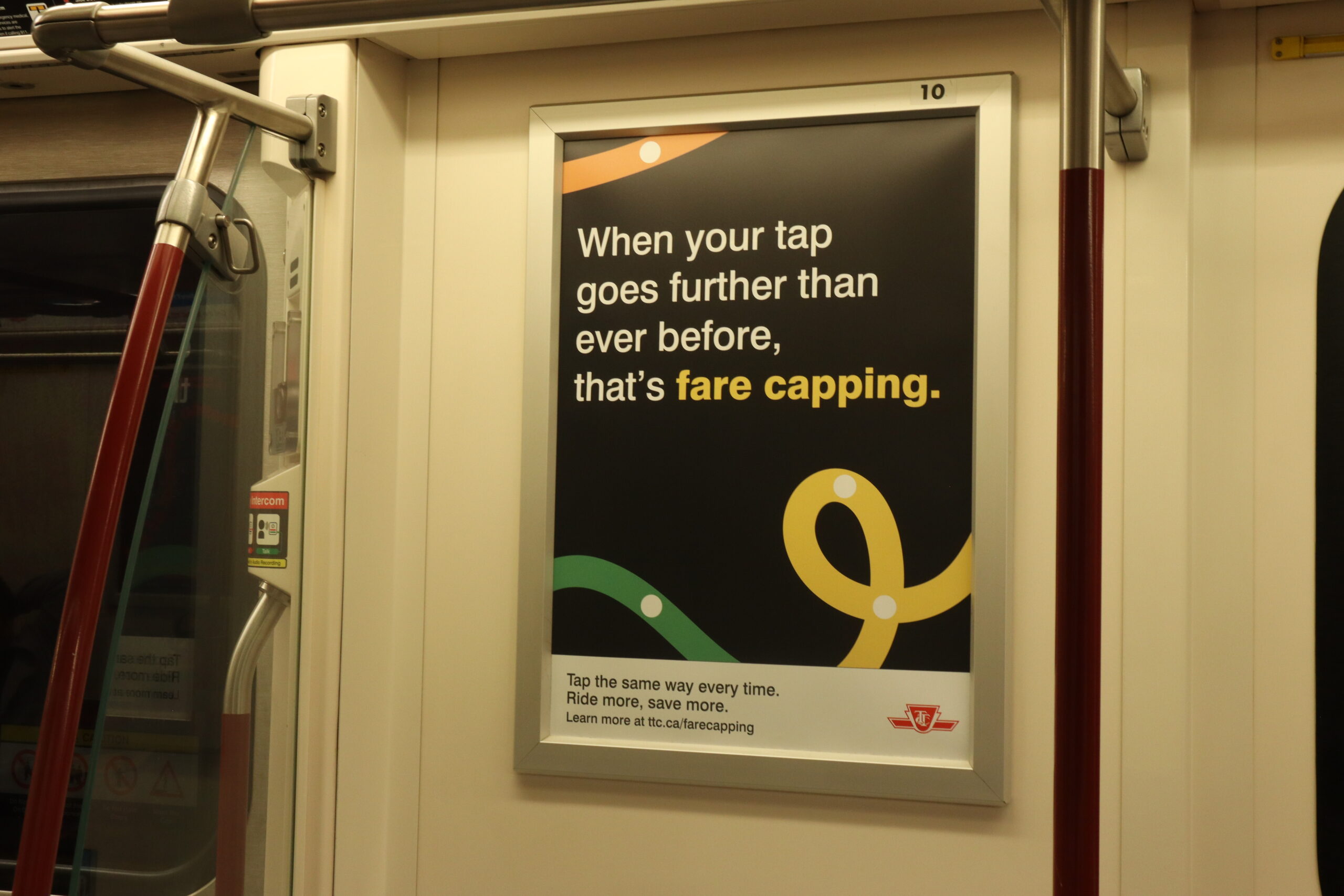
Another recent change the TTC has added is a fare capping system. The TTC has explained that “starting on Sept. 1, Adult, Youth, Senior and Fair Pass customers who pay with a PRESTO, debit, or credit card automatically ride free after reaching 47 paid trips in a calendar month.” It should be noted that the free transfer taps do not count towards the fare capping.
Burke mentions that the system is useful for people who frequently use transit, adding that “if there’s a limit, it becomes a little bit cheaper.” However, some are not as swayed by the new system. Lee believes that while the idea is good in theory, the amount of required taps restricts its utility. “47 times,” Lee remarks, “that’s a lot. Most of the time I [wouldn’t] actually get to use the [fare] capping system.” Agha agrees, highlighting that “if you do the calculations, it’s going to be the same as getting a monthly membership.”
Although incumbent mayoral candidate Oliva Chow has added weekly fare capping to her platform, there have been no major mentions of student fare capping. Currently, the Adult fare cap totals $155.10 per month, higher than both the Adult 12-month Pass and Post-Secondary Pass, which are $143 and $128.15, respectively.
What’s the Next Stop?
While the TTC is aiming to move in the right direction through large-scale planning, several derailments stand in its way: construction delays, rider apprehension, massive taxpayer costs, and Toronto’s ever-increasing population. Members of the York community who rely on the system can only hope that it stays on track.
